About

A measurable pathway out of educational isolation.

Nuristan Education Initiative is a California nonprofit public benefit corporation recognized by the Internal Revenue Service as a tax-exempt public charity under Section 501(c)(3) of the Internal Revenue Code, carrying forward a program that has already been tested on the ground.

Mission & vision

Why the Initiative exists.

Our mission is to expand equitable access to higher education for marginalized youth in Nuristan, Afghanistan — by building a measurable pathway from weak primary and secondary schooling to competitive performance on Afghanistan's national university entrance system.

Our vision is a sustainable, community-rooted cohort of Nuristani students — girls and boys — who gain university access, succeed in urban academic settings, and help break the province's long-standing cycle of educational isolation and constrained opportunity.

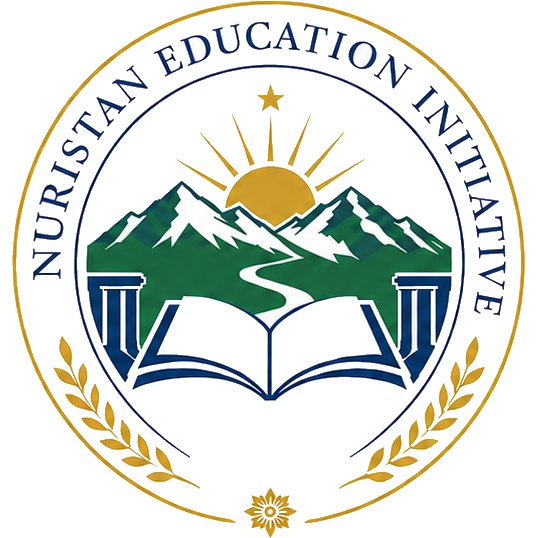
The Nuristan Education Initiative emblem — mountains, an open book, a rising sun, and laurel branches within a circular seal.
Our emblem

The story in our seal.

Our emblem is built to be read. The circular seal signals seriousness and accountability — an organization meant to be both community-rooted and institutionally credible, built to serve students and earn donor trust.

At its center stand the mountains of Nuristan — the region's identity and resilience, but also the barrier at the heart of this work. In remote valleys, geography shapes school quality, access to teachers, and the chance to prepare for the national university entrance exam. Two columns flank the mountains, evoking the institutions of higher learning the Initiative helps students reach.

Path and promise

From the open book at the base — education as the foundation of opportunity — a path rises toward the mountains and a rising sun. That path is the emblem's central idea: education is a route forward, built on preparation, discipline, and persistence. The sun stands for hope and renewal — for Nuristani students, girls and boys, reaching university and helping break a long cycle of educational isolation.

Achievement and dignity

The gold laurel branches speak to achievement and dignity — not short-term aid, but the preparation and confidence to compete, succeed, and one day serve their own communities. The tagline beneath the wordmark, “Transforming Lives Through Education,” carries that conviction outward.

The place & the pilot

Why Nuristan, and why now.

Geography and access

Nuristan lies within steep, wooded valleys south of the main Hindu Kush ridge. The provincial capital, Parun, is more than eight hours by road from Jalalabad, and the province has long had weak access to basic services — education, health, water, and roads alike.

Language from the first day of school

The region is also culturally and linguistically distinct. Its people speak languages of the Nuristani group, while Afghan textbooks and classroom instruction come only in Dari or Pashto. Nuristani children begin school at a disadvantage from the first day. Annexed into the modern Afghan state in 1895–1896, the province has carried a long history of marginalization, limited institutional development, and exclusion from opportunity — which is precisely why it is a consequential place to test whether disciplined academic support can change outcomes.

Why the Kankor matters

In Afghanistan, public university access depends heavily on the national Kankor exam. Students in remote Nuristan often reach that exam without the same preparation, language support, or academic reinforcement available elsewhere. The Initiative's two programs are built around that concrete pathway — not generic schooling support.

From pilot to nonprofit

The model has already been tested through privately financed implementation. The Nishegram after-school program is in its fourth year, serving 50 to 60 students. The Kabul Bridge Cohort now supports six students through intensive preparation. Given the demonstrated demand and early traction, establishing the work as a California nonprofit recognized by the IRS as a 501(c)(3) public charity has given it the governance and fundraising platform it now needs.

What guides us

Four commitments.

Measured, not assumed

We publish targets the board can support and report figures we can defend. Where a measurement system is still being built, we say so.

Rooted in the community

Programs run on local permission, parent and guardian agreements, and teachers recruited locally wherever capacity allows.

Discreet by design

In a sensitive context, the safety and local legitimacy of students and staff come before public visibility — always.

Accountable

Independent review of accounts, a conflict-of-interest policy, and a board that governs the use of every dollar.

Governance

How the Initiative is run.

The Initiative's bylaws set a conventional, accountable nonprofit structure.

Board of Directors

Three to fifteen directors serving staggered three-year terms, meeting at least quarterly. The board governs the Initiative, sets policy, and oversees all activities and assets.

Officers

A President, Vice President, Secretary, and Treasurer, elected by the board, each serving one-year terms.

Committees

Standing committees — including finance, audit, and program — support the board's oversight, with additional committees formed as needed.

Fiscal policy

A January-to-December fiscal year and funds held in federally insured institutions. Financial records will be maintained for board review and independent CPA review or audit as required.

Conflict of interest

Directors, officers, and staff must disclose any actual or potential conflict; interested persons abstain from related discussion and votes.

No private benefit

No part of the Initiative's earnings may benefit a private individual. On dissolution, remaining assets pass to other tax-exempt charitable organizations.

Board of Directors

The founding board is being seated as part of the Initiative's formation. Directors, officers, and committee assignments will be listed here once confirmed.

Safeguarding

Protecting the students we serve.

Afghanistan is the only country in the world where secondary and higher education are broadly prohibited for girls and women; UNESCO reports that nearly 2.2 million girls are barred from school beyond the primary level. In Nishegram, local authorities currently permit the program to operate, including girls' participation. Rural and remote areas can present different operating conditions than major cities — but we treat girls' participation as a managed, continuously monitored area of program risk, never as a settled condition.

Public storytelling and student privacy

We use discretion in public storytelling and avoid identifying students without appropriate consent and safety review. Our reporting emphasizes aggregate progress, program structure, and educational outcomes while protecting students and communities.

No identifying imagery

This website carries no identifying photographs of program participants. Illustrations stand in for images we will not publish. Any future photography requires guardian consent and a risk review, and defaults to non-identifying framing.

Discretion in communications

Public visibility is managed deliberately. We avoid precise locations, schedules, and any detail that could place students, families, or staff at risk.

Family agreements

Participation rests on agreements signed by parents or guardians — reinforcing continuity of attendance and shared ownership of each student's progress.

Aggregate reporting only

Donor-facing reporting uses aggregate figures. Identifiable student data stays with the program and is never published.

Contact

Get in touch.

For questions about the programs, giving, or partnership — including donor-advised funds, employer matching, and major or multi-year gifts — email the team directly.

For the safeguarding reasons described above, we do not publish a street address or the contact details of staff on the ground.

Stand with students in Nuristan.

A modest budget, careful governance, and a clear pathway. Your gift moves it forward.